

Technically reviewed by Maximilian Fromm, independent vehicle expert (B.Sc. in Mechatronics). Last updated: September 2026
After an accident that was not your fault, you may be entitled to more than the repair: money for the time without a car, compensation for diminished value, and a flat amount for your effort. This guide shows how the process works and what the amounts depend on.
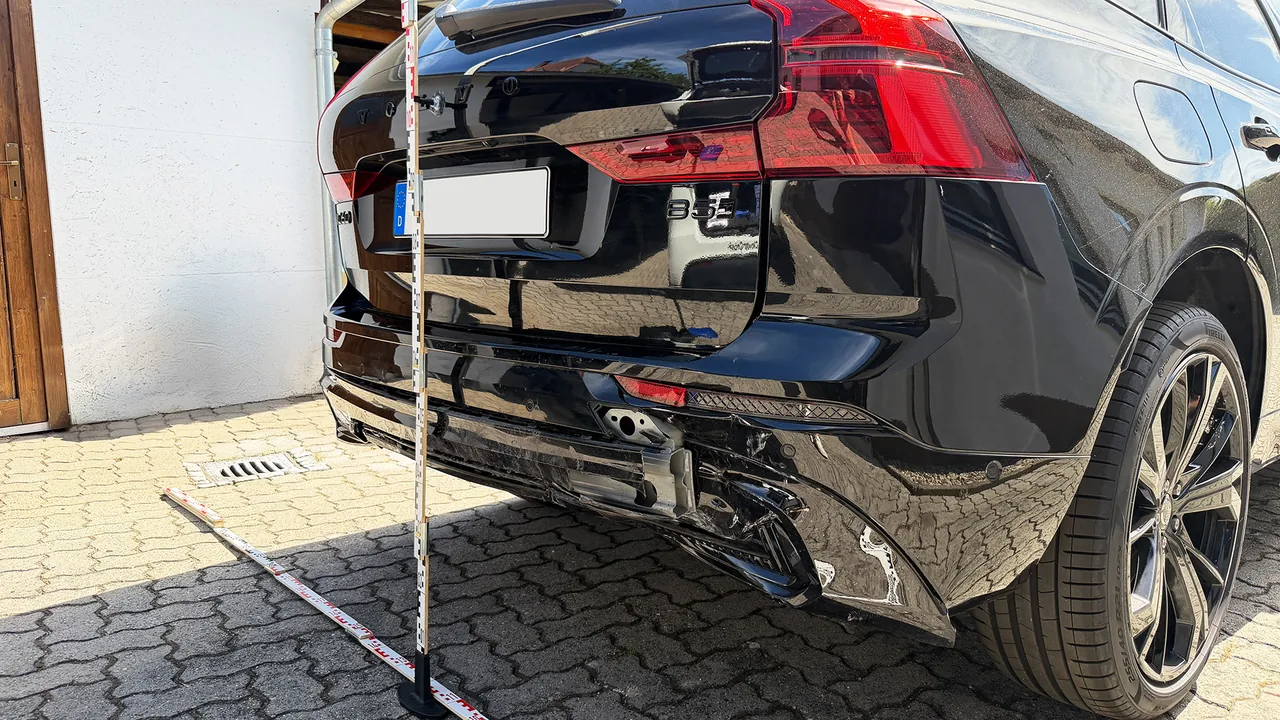
Right after an accident, the order of actions matters most, not background knowledge. If someone is injured, they get help first. The accident scene is secured. Only then come photos and the exchange of name, address and insurer with the other party.
Do not sign anything at the accident scene that assesses who is at fault. You must still give your name, address and insurer. The two things are not connected.
This summary does not replace instructions for the emergency itself. The checklist for the accident scene guides you through every step in the right order, from securing the scene to the phone call.
The person whose car was damaged has their own claims under the law. This does not depend on how the other party's insurer classifies the damage. In principle, the person who caused the accident must place you in the same financial situation as if the accident had not happened. This applies to the repair, to the time without a car and to diminished value.
This also includes the free choice of your own independent vehicle expert: You decide who determines the damage, not the other party's insurer.
After an accident that was not your fault, you do not pay in advance. The other party's liability insurance usually pays the costs of the report (Gutachten).
Eight points that are often overlooked in practice:
The independent vehicle expert determines the damage technically: the extent of the damage, the repair method and, where needed, whether prior damage (Vorschaden) is plausible. This is different from a repair estimate (Kostenvoranschlag) from the repair shop. The estimate only calculates the repair itself, not the whole damage with all items. How we create a damage report (Unfallgutachten) is shown on the page Damage report.
This also differs from the opinion of a reviewer whom the insurer hires. The independent vehicle expert works for you and the reviewer works for the insurer. Two technical opinions on the same damage can differ.
You choose the independent vehicle expert yourself. A suggestion from the insurer is only an offer. What matters when you choose is explained on our page about how to recognize a good independent vehicle expert.
The report is usually free of charge for you, because the other driver's insurer pays the fee.* For very minor damage, you pay the costs yourself, and there is no fixed limit for this. The footnote at the end of the page explains which other cases apply. What a report costs and who pays in which case is explained on the page Cost of a vehicle report.
Before we start the repair cost calculation, we carefully wipe off foreign paint or tire marks. We take photos before and after. This is the only way to tell whether the paint underneath is damaged or the foreign paint only sits on top.
Have these six things ready for the inspection:
How long the whole claim settlement takes is different in every case. The inspection usually takes place within one to three working days. The report is usually ready after another two to five working days. How long the insurer needs to pay depends on the case. What it depends on is explained on the page how long a vehicle report takes.
Trust comes from facts you can check, not from words alone. We are reachable 24/7, based in Erlangen and active in the whole Nuremberg Metropolitan Region.
Feedback from people whose cars were damaged and whom we supported.
View reviewsWhere your vehicle is inspected, with a vehicle lift and a photo studio.
View Workshop pageWhere we inspect vehicles on site.
View service areasLoss-of-use compensation (Nutzungsausfall) and diminished value (Wertminderung) are separate items of damage. They are not a goodwill gesture from the insurer.
For the days when your vehicle cannot be used, you are usually entitled to a flat amount, based on the vehicle class. Depending on the class, the daily rate is between €23 and €175. You can find the daily rate for your vehicle on our page about this. A normal repair usually takes 10 to 14 days. It can take longer if spare parts are delayed. The common 14 days are a rule of thumb used by insurers, not a legal rule. What counts is the repair time or the time needed to buy a replacement car, as calculated in the report.
Even a professionally repaired vehicle loses value, simply because it counts as a car that had an accident. This is called diminished value. It is usually paid in addition to the repair costs. Only under the 130% rule (130-Prozent-Regel) is diminished value added to the repair costs when checking the 130% limit. More on this below.
For very minor damage, there may be no diminished value. For older vehicles, the used car market decides: If it pays more for a vehicle without accidents than for a professionally repaired one, diminished value remains. Age or mileage alone does not decide this.
In two of our three calculation examples, diminished value is 7 to 9% of the replacement value (Wiederbeschaffungswert). This is what a comparable vehicle costs on the regional market. In the third example it does not apply at all. How the amount is calculated is explained on the page about Diminished value.
For small expenses caused by the accident, such as phone calls, trips and postage, there is also a flat-rate expense allowance (Unkostenpauschale), with no individual proof needed. Courts usually award between €20 and €30 for this. What the flat-rate expense allowance covers exactly is explained in the glossary.
A specialist lawyer for traffic law can tell you how the law applies to your case.
Whether a repair is worth it depends on the ratio between the repair costs and the replacement value. This is the amount you would pay for a comparable vehicle on the regional market. If the repair costs are clearly above this value, it is called an economic total loss (wirtschaftlicher Totalschaden). Then only the replacement expense (Wiederbeschaffungsaufwand) is paid: the replacement value minus the residual value (Restwert). What this means exactly is explained on the page when a repair becomes a total loss.
The 130% rule sets the limit for this: Repair costs and diminished value together may be up to 130% of the replacement value. The condition is that the vehicle is repaired professionally and completely as calculated, and then used for at least six months. If both together are above this, the settlement is made on a total loss basis, that is, on the replacement expense. If you sell the vehicle within this period, the settlement is also made on the total loss basis. The exact mechanics are explained on the page 130% rule in detail.
If you settle on a total loss basis and sell the damaged vehicle, you may rely on the regionally determined residual value from your report. You do not have to search the internet for higher offers yourself. Suppose you receive a specific higher offer before the sale, and you can accept it without difficulty. Then ask your lawyer to check it before you sell.
A specialist lawyer for traffic law can tell you how the law applies to your case.
Below the replacement value, you do not have to have the car repaired. You may have the compensation paid based on the report without repairing. This is called fictitious settlement (fiktive Abrechnung). As long as you do not have the damage repaired, you may only keep driving the car if it is roadworthy. For a leased vehicle, fictitious settlement is usually excluded: The leasing company is the owner, and the contract usually requires the repair.
The replacement expense is the replacement value minus the residual value. The repair costs may be between this amount and the replacement value. In that case, you receive the full repair costs only if you keep using the vehicle for at least six months after the accident. If you sell the vehicle before these six months end, you receive the replacement expense.
If the repair costs are above the replacement value, you are entitled to the replacement expense even without a repair. You can get more than this only within the 130% limit. You also need proof of two things. The repair was done professionally and completely as calculated. You then used the vehicle for at least six months. If repair costs and diminished value together are above 130% of this value, even a complete repair does not change the payment.
If you later decide to repair after all, you can claim the VAT afterwards by submitting the repair invoice. Without a repair invoice, VAT is not paid.
If the insurer refers you to a cheaper repair shop (Werkstattverweisung) under this type of settlement, it must explain and prove that the shop is equal in quality and reasonable for you. Hourly labor rates (Stundenverrechnungssätze) differ a lot between repair shops. What matters here is explained on the page about fictitious settlement.
A specialist lawyer for traffic law can tell you how the law applies to your case.
Before the insurer pays on a report, it often has the report checked again, internally or through a review company working for the insurer. An insurer review report (Prüfbericht) is made on behalf of the insurer and usually without inspecting the vehicle. In court it therefore does not have the weight of a report.
Five items are often removed or reduced:
The arguments about the expert's fee are in the knowledge hub. The arguments about repair costs and hourly rates are on the page about fictitious settlement.
An entry in the Hinweis- und Informationssystem (HIS, the insurers' information system) is independent of the question of fault. It records unusual claims, usually for several years. What the HIS entry means is explained on its own page. Prior damage on your own vehicle that was not disclosed also often leads to a reduction. The glossary explains how to tell prior damage and old damage (Altschaden) apart.
A specialist lawyer for traffic law can tell you how the law applies to your case.
Eight arguments from insurer review reports against the expert's fee, and how the report answers them.
View topic ServiceWhen an insurer review report removes items that are justified in the report.
View serviceThe independent vehicle expert determines the damage technically. Pursuing a claim legally is the job of a lawyer. Our support until payout means that we explain the technical points of each reduction and give an expert statement on them. We do not negotiate with the insurer and do not write demand letters. Your lawyer takes over legal representation if needed.
A lawyer makes the most sense if there is a dispute about fault, if there is personal injury, or if the insurer refuses to settle the claim. After an accident that was not your fault, the cost of a lawyer is usually part of the damage that is reimbursed. With shared liability (Mithaftung) or a very simple case, this can be different.
If the insurer offers a final settlement agreement (Abfindungsvergleich), it usually rules out later claims. Have a specialist lawyer for traffic law review it before you sign.
A specialist lawyer for traffic law can tell you how the law applies to your case.
After an accident that was not your fault, the motor vehicle liability insurance of the person who caused the accident pays, not your own insurer. This applies equally to repair costs, loss-of-use compensation, diminished value and the other items in this guide.
You have your own claims under the law. Examples are an advance payment, the free choice of repair shop, or your own evidence documentation by an independent vehicle expert you choose. The individual rights are described further up in this guide and on our knowledge page about this.
It is not always needed, but it is often useful, for example if there is a dispute about fault, if there is personal injury, or if the insurer refuses to settle the claim. Who pays for it is explained further up, in the chapter that separates the independent vehicle expert from the lawyer.
After the claim notification (Schadenmeldung), the insurer checks liability while your independent vehicle expert inspects the vehicle and writes the report. How long each step takes is explained further up, in the chapter about the independent vehicle expert.
An advance payment is a partial payment on the expected damage before the claim settlement is fully complete, for example when the insurer's review takes a long time. A specialist lawyer for traffic law can tell you how the law applies to your case.
Usually not: After an accident that was not your fault, the other driver's insurer pays the fee, and you do not pay in advance. In four cases you pay yourself: with shared liability, with minor damage (Bagatellschaden), if the insurer reduces the fee, and if you settle through your own vehicle insurance. We tell you in advance what applies to your case in the free initial assessment.
Bookmark the checklist and save our number. Then you can find both again when you need to act fast.

* You do pay yourself in four cases: if you share liability for the accident, for minor damage, if the insurer reduces the fee, and if you settle through your own vehicle insurance. We tell you in advance what applies to your case in the free initial assessment.
CleverCrash is an office of independent vehicle experts, not a law firm. This page is general consumer information and does not replace legal advice in an individual case. Amounts and deadlines are rough guides, not promises. Last updated: September 12, 2026. The page reflects the case law known at that time.
Maximilian Fromm
Independent vehicle expert, B.Sc. in Mechatronics
Maximilian Fromm is an independent vehicle expert and the founder of CleverCrash in Erlangen. He studied mechatronics. Since August 2025, he has written damage reports (Unfallgutachten) for private customers, repair shops and lawyers in the Nuremberg Metropolitan Region. He supports his customers until the insurer pays out.
