

Technically reviewed by Maximilian Fromm, independent vehicle expert (B.Sc. in Mechatronics). Last updated: September 2026
Even a professionally repaired car can lose value on the market after an accident, because buyers pay less for an accident car than for an accident-free vehicle. In damage law, this loss in value is called diminished value (merkantile Wertminderung, also called merkantiler Minderwert). It is a separate item of damage next to the repair costs. We determine whether it applies to a specific vehicle and how high it is, based on the market, in the damage report (Schadengutachten).
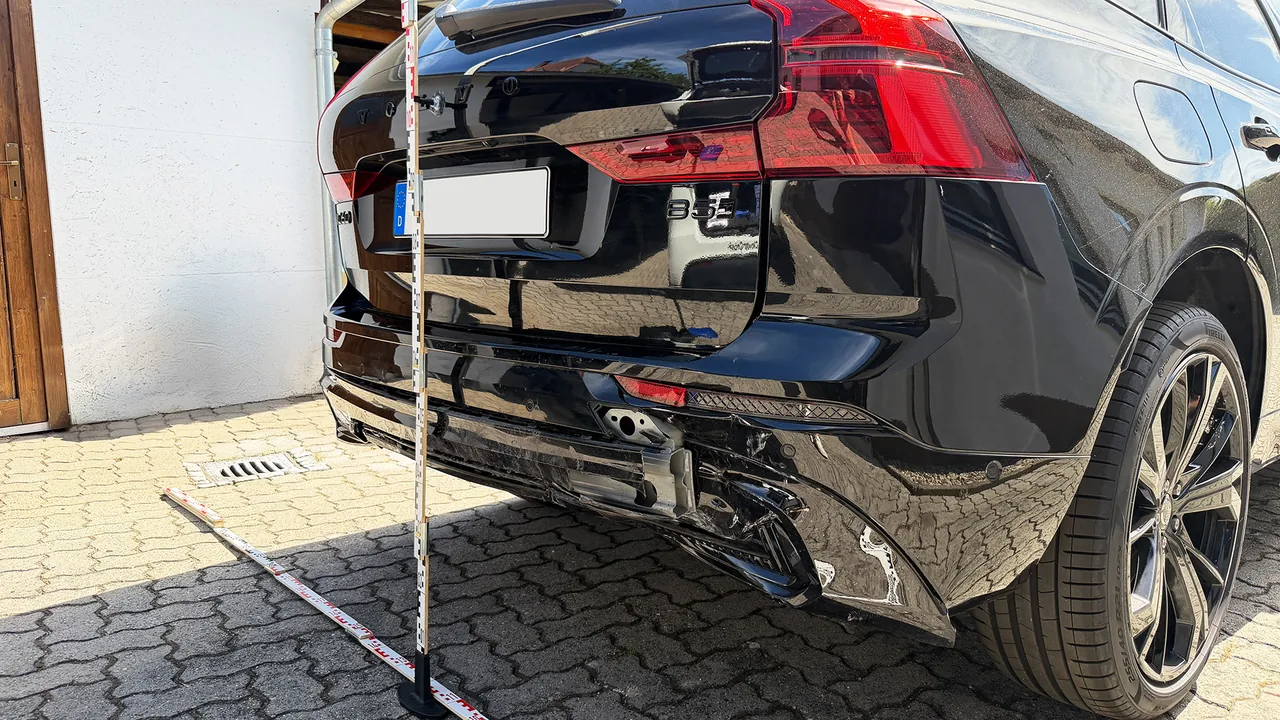
Imagine this: Your car is damaged in an accident that was not your fault. The repair shop repairs it correctly, as specified. Even so, buyers on the used car market pay less for a car that had an accident. This market discount is its own damage item next to the repair costs. It is called diminished value and has been recognized as direct property damage for decades.
Diminished value does not come from an incomplete repair. It comes from buyers who are generally suspicious of accident cars. The key idea is hidden damage.
Diminished value is paid in addition to the repair costs. It is part of your damage and is not offset against the repair costs.
The amount comes from the market, not from a formula. An independent vehicle expert determines it in the damage report.
We determine diminished value based on the market and handle the billing directly with the other party's insurer.
There is no formula required by law, and an online calculator gives only a rough guide. Experts use several established methods as an estimation aid under § 287 of the German Code of Civil Procedure (ZPO). The table below gives an overview of the common methods. Ruhkopf/Sahm, for example, compares the repair costs with the replacement value (Wiederbeschaffungswert) and scales the result by vehicle age. The method is meant for young vehicles up to about five years old. What counts in the end is this: how does the used car market value a comparable vehicle with a documented accident history?
| Method | Author and year | Basis of calculation |
|---|---|---|
| Ruhkopf/Sahm | 1962 | Ratio of repair costs to replacement value, plus an age table |
| Halbgewachs | goes back to a DEKRA procedure from 1964 | full repair costs with labor and material shown separately, new price, vehicle age in months and sales value before the accident |
| Hamburg model | developed by the Higher Regional Court of Hamburg (OLG Hamburg, judgment of October 6, 1981, 7 U 105/80) | is used in practice only there |
| Bremen model | Origin Bremen, year not consistent in the literature (1970 or 1986) | simpler than Ruhkopf/Sahm and Halbgewachs, uses only vehicle age and repair costs |
| Market relevance and factor method (MFM) | Zeisberger, Woyte, Schmidt and Mennicken, 2012, Kirschbaum Verlag | Factor model with market relevance factors and vehicle factors |
| BVSK model | Bundesverband der freiberuflichen und unabhängigen Sachverständigen für das Kraftfahrzeugwesen e.V. (a German association of independent vehicle experts) | own variants for cars, motorcycles and trucks |
| Dr. Trümner | Dr. Marc Trümner, doctoral thesis 2014 (Technische Universität Bratislava) | Factor model made from replacement value, new price and four factors for damage, marketability, prior damage and as-new condition |
| Difference method or market comparison method | not a calculation model, but a direct comparison on the used car market | What does a comparable vehicle with a documented accident history cost, compared with an accident-free one? More work, but closest to what really happens on the market. |
Four leading decisions of the BGH shape the case law on diminished value.
| Date | Case number | Key point |
|---|---|---|
| April 29, 1958 | BGH VI ZR 82/57 | The basic decision on diminished value (BGHZ 27, 181). It treats the loss in value as compensable damage, because restoring the car does not make up for it. The market discount remains even after a professional repair. |
| October 3, 1961 | BGH VI ZR 238/60 | Diminished value must also be paid when the owner keeps using the car and does not want to sell it at all (BGHZ 35, 396). So the loss in value does not depend on an actual sale. It arises as soon as the car is damaged. |
| December 8, 1981 | BGH VI ZR 153/80 | Diminished value is direct damage to the substance of the vehicle. So it is a separate item of damage next to the repair costs and not a calculation item inside the repair costs. The court decided this for a claim under your own vehicle insurance (Kaskoschaden). The same rule applies to other claims too. The argument that diminished value is already covered by the repair costs is therefore not correct. |
| November 23, 2004 | BGH VI ZR 357/03 | There is no fixed kilometer limit for diminished value. What counts is how the used car market values the car, not a flat threshold of 100,000 kilometers. From the judgment: "Diminished value is a reduction of the resale value. It remains even after complete and proper repair of a motor vehicle that was badly damaged in an accident. The reason is that a large part of the public, mainly because of the suspicion of hidden damage, does not want to buy accident-damaged motor vehicles, and this affects the price." |
Not every scratch counts. Not every minor scratch leads to diminished value. In practice, some rules of thumb are used. The BGH has not decided on them. In the damage report, we check each case: amount of damage, affected parts, a possible entry in the damage history record and the vehicle age.
Not every minor scratch leads to diminished value. In practice, some rules of thumb are used. The BGH has not decided on them. Experts check each case.
In our practice, we start checking at about this amount of damage. This is a figure based on the experience of our office, not a limit from case law. Below it, measurable diminished value is rare. Above it, a check makes sense. The higher the damage, the higher the chance.
If the accident affects structural body parts (frame rails, A, B and C pillars, floor pan), diminished value is clearly higher than for bolt-on parts alone.
Any documented prior damage lowers the market price in a way that can be proven. Here, diminished value is often the most expensive item in the report.
The Federal Court of Justice (BGH) has made the 100,000-kilometer limit less rigid. It deliberately did not set a fixed age limit. Diminished value can also apply to cars with higher mileage. It depends on the market.
The following three cases come from our practice. Vehicle data are anonymized and amounts are rounded, so that no one can identify individual clients. All amounts are net values, because diminished value is calculated from net sales prices. Which method is used in a single case depends on the vehicle and the market. None of the three numbers could be derived from a formula alone.
| Item | Case A | Case B | Case C |
|---|---|---|---|
| Vehicle | Upper mid-size SUV | Small car | Mid-size SUV |
| Age at time of damage | 3 months | 1 year 8 months | 12 years |
| Mileage | 2,700 km | 21,800 km | 261,000 km |
| Replacement value | €50,000 | €15,500 | €8,250 |
| Repair costs | €17,100 | €8,800 | €2,350 |
| Affected areas | Tailgate, rear panel, side panel, sensors | Door, side panel, pillar, sill reinforcement | Fender, no structural part |
| Diminished value | €4,500 | €1,100 | €0 |
| Share of replacement value | 9.0% | 7.1% | 0% |
A vehicle three months old with 2,700 kilometers is almost like a new car on the market. At €17,100, the damage is by far the largest of the three cases. The rear damage reached the rear panel and the side panel, and the body had to be measured. Damage of this size stays in the vehicle history for good. When the car is resold, the damage lowers the price compared with a similar accident-free vehicle.
This vehicle is also young and has low mileage, but it is not as close to a new car as the vehicle in Case A. The damage is also much smaller, €8,800 against €17,100. Together, these two points explain the lower discount. Which parts are affected matters less here than age and amount of damage.
The vehicle is twelve years old and has 261,000 kilometers. The fender was damaged when someone opened a door against the parked car. It was repaired and painted. No structural part was affected, and no axle or body measurement was needed. At this age and mileage, the used car market no longer separates accident-free cars from professionally repaired ones. There is no price gap that could be deducted.
All items of damage. After an accident that was not your fault, several items belong to the compensation for damages. In case of shared liability (Mithaftung), the costs are paid in proportion. We record the technical and economic items in the damage report. This is the basis for your traffic law lawyer to assert the claim:
Before you ask: here is what people most often want to know about diminished value. Case law sets no fixed minor damage threshold (Bagatellgrenze), neither in euros nor in percent. The age of the vehicle alone does not rule out diminished value either. We answer the most common questions in detail below, for clients in all of Erlangen, Nuremberg, Fürth and the Nuremberg Metropolitan Region.
The market-based diminished value is the market discount that remains despite a professional repair. It comes from the stigma of an "accident car". The technical diminished value covers, in contrast, losses in value because parts of the car were not fully restored, for example when a crushed structural part was repaired instead of replaced. In practice, market-based diminished value is the most common type, because modern repair methods usually avoid technical defects.
The courts have not set a fixed minor damage threshold (Bagatellgrenze), either in euros or in percent. In our practice, we check whether diminished value applies when the damage is about €750 or more. From about €1,500 to €2,000, we regularly include diminished value. These figures come from our office's experience, not from court rulings. Repair costs of about 10% of the current value or more also serve as a relative guide. This mark is not applied rigidly either. What matters is not the repair total alone, but where the damage is. Structural parts trigger diminished value earlier than add-on parts.
Age alone does not rule out diminished value. In practice, people often name a rule of thumb of about five years and 100,000 kilometers. It is not a fixed limit from law or from the highest courts. In 2004, the BGH made clear that 100,000 km is no longer a fixed upper limit (BGH, judgment of November 23, 2004, VI ZR 357/03, BGHZ 161, 151). The reason: mileage matters less on the used car market today. The BGH deliberately left a fixed age limit open. The individual case decides. Whether a vehicle that is six or eight years old carries a loss in value depends on how the used car market values exactly this model with documented accident damage. Case C in the table above shows that it can end differently. With twelve years, 261,000 kilometers and fender damage without structural parts, no price gap remained. We check this on the vehicle.
Diminished value is a separate item of damage. According to the case law of the Federal Court of Justice, it does not depend on whether the vehicle is actually repaired or sold. It must be determined and explained in the report based on the market. A traffic law lawyer handles asserting the claim against the insurer.
Diminished value is calculated from net sales prices, whether or not the owner of the damaged car is entitled to deduct input VAT (vorsteuerabzugsberechtigt). If the value is estimated from gross prices on the used car market, the VAT in those prices must be deducted (BGH, judgment of July 16, 2024, VI ZR 188/22, NZV 2024, 587). Paying diminished value is not itself a transaction subject to VAT. We show diminished value in the report as a net amount. Still, tell us when you order whether the vehicle is used for business. This matters for other items in the report.
A rough idea from rules of thumb is possible. The overview of methods further above shows which values go into them. An independent vehicle expert determines a reliable amount in the damage report. This amount can be checked in a dispute, and the expert explains it with market data. Only in a dispute does the court set a binding amount under § 287 ZPO (German Code of Civil Procedure). Insurers check the amount of the diminished value and can reduce it. A well-reasoned report makes the amount clear.
Yes, if the damage still affects the market. Diminished value depends on the damage itself, not on where and how it happened. This also applies to damage in a repair shop, for example damage from moving the car on the shop grounds or damage during work on the vehicle. The same points count as after an accident: which parts are affected, how large the damage is and how the used car market values the repaired vehicle. We determine the damage and the diminished value in the report, no matter who caused the damage. A lawyer clarifies against whom the claim is directed and on what basis.
The liability insurance of the driver who caused the accident. Diminished value is part of the claim for compensation for damages. It is billed together with repair costs, loss-of-use compensation and the usual additional costs. If the other party is fully liable, the report costs are usually part of the damage that is reimbursed. In case of shared liability, they are reimbursed in proportion.
That depends on your contract. Against the other party's liability insurance, the claim to diminished value comes from the law of compensation for damages. Whether your own comprehensive coverage (Teilkasko) or collision and comprehensive coverage (Vollkasko) pays diminished value is set by the policy terms of your contract. Many policy terms exclude diminished value. Some insurers offer it as an add-on. Some of these add-ons apply only after an accident, vandalism or a collision with a wild animal (Wildunfall). In that case, hail damage is not covered. What applies to your vehicle is in the terms of your contract. Whether there is diminished value at all is judged by the same standard for hail damage and paint damage as for accident damage. The type of damage does not count. What counts is how the used car market values the repaired vehicle. The size of the damage, the affected parts and the documented entry in the vehicle history matter here.
This happens. The other party regularly has reports checked again by its own review companies (Prüfdienstleister). An independent damage report is the reliable basis for this. If the insurer keeps the reduction (Kürzung), we recommend a traffic law lawyer. We receive no commission for this. If the other party is fully liable, lawyer's fees are usually part of the damage that is reimbursed. In case of shared liability, they are reimbursed in proportion.
These topics are closely linked to diminished value.
When may you repair the car despite an economic total loss (wirtschaftlicher Totalschaden)? Open topic
Economic total loss, technical total loss and constructive total loss of a new car compared. Open topic
Money for not being able to use your vehicle during the repair. Open topic
The overview of all topic pages about vehicle damage. Go to overview
Direct line to the expert: After an accident that was not your fault, the other party's liability insurance pays the costs of an independent damage report as part of compensation for damages under Section 249 BGB. If you share fault, the amount is paid in proportion. For very minor damage, it is usually not paid. In a claim under your own vehicle insurance (Kaskoschaden) against your own insurer, you generally pay the costs of an independent vehicle expert you hired yourself. This follows from Section 85(2) VVG. We come to you, throughout Erlangen, Nuremberg, Fürth and the Nuremberg Metropolitan Region, and determine the market-based diminished value with a clear link to the used car market. Or use our online form to report damage: fill it in briefly and send it. We will contact you as soon as possible.

Legal information, not legal advice. Your lawyer handles the legal assessment of your specific claim. CleverCrash prepares the technical damage report as an independent vehicle expert.
CleverCrash is an office of independent vehicle experts, not a law firm. This page is general consumer information and does not replace legal advice in an individual case.
Last updated: August 26, 2026. The page reflects the case law known at that time.
Maximilian Fromm
Independent vehicle expert, B.Sc. in Mechatronics
Maximilian Fromm is an independent vehicle expert and the founder of CleverCrash in Erlangen. He studied mechatronics. Since August 2025, he has written damage reports (Unfallgutachten) for private customers, repair shops and lawyers in the Nuremberg Metropolitan Region. He supports his customers until the insurer pays out.
