

Technically reviewed by Maximilian Fromm, independent vehicle expert (B.Sc. in Mechatronics). Last updated: September 2026
An HIS entry is a note in the Hinweis- und Informationssystem (HIS, the insurers' information system) of the German insurance industry. An insurer reports a case there when something looks unusual. After an accident this does not happen automatically. According to the operator, typical reasons are a Total loss, a fictitious settlement (fiktive Abrechnung) or unusual features in an earlier claim notification (Schadenmeldung). You can find out if there is an entry for your car or for you with the free HIS check. You do this with a data access request (Selbstauskunft) under Article 15 of the General Data Protection Regulation (GDPR, DSGVO). An entry is not an accusation of fraud. But insurers may check later claims more closely. Only the insurer that reported the case can delete or correct the entry.
The little-known information agency of the insurance industry, and how to find out if you are in it.
Free data access request under Art. 15 GDPR. All key facts on storage period, deletion and the HIS check. From a mechatronics engineer and independent vehicle expert.

Maximilian Fromm
Founder and Mechatronics Engineer (B.Sc.)
HIS is an information agency of the insurance industry that covers all insurance sectors. In everyday language it is also called the "black list of insurers" or, earlier, "Wagnisdatei". Insurers report unusual claims to it. Other insurers can see this information when they run an HIS check. A government agency does not run the system. A private service provider runs it for the GDV (the German insurance association).
| Operator | Besurance HIS GmbH (since October 1, 2025, before that informa HIS GmbH) |
|---|---|
| Data access request online | besurance-his.de/selbstauskunft |
| Storage period | Reports: deleted at the end of the fourth calendar year after the first storage. If the case is reported again, add four years, but no more than 10 years. Data on HIS requests: deleted on the exact day after two years. Source: Besurance HIS, information under Art. 14 GDPR |
| Legal basis | Art. 6(1)(f) GDPR (legitimate interest) and the Code of Conduct of the German insurance industry (Code of Conduct GDV) |
Many people think HIS is one database. It is not. It has seven separate sectors, and each has its own rules. A report in one sector does not automatically become visible in another sector.
Insurers report claims to HIS when something looks unusual to them, or when there is a typical reason such as a total loss or a fictitious settlement. When the next insurer runs an HIS check, it sees the match. HIS is separated by sector. The triggers below apply to vehicles. A report does not happen automatically and not for every claim.
Many false ideas about HIS persist, and they are not true in practice. Here are the most important corrections.
Five statements about the HIS entry come up again and again. Here is how it works in practice under the Code of Conduct GDV and the GDPR.
| What people often claim | What is true under the Code of Conduct GDV and the GDPR |
|---|---|
| "It is a black list. You never get out." | It is an information agency with clear deadlines. You have a right to erasure under Art. 17 GDPR if a report was wrong (in individual cases, because case law is not consistent, see the section on court decisions below). |
| "The standard storage period is 5 years." | 4 calendar years as standard (Code of Conduct GDV), a maximum of 10 years if the case is reported again. |
| "With an HIS entry you are rejected automatically." | There is no automatic reason for rejection. An entry only gives the insurer a reason to check more closely. |
| "All insurers can see your HIS data." | The data is separated by sector. Only insurers in the same sector see the entry. |
| "A data access request costs a processing fee." | The data access request is free of charge under Art. 15 GDPR. A fee can only be charged if requests are clearly excessive. |
Imagine this: three rear-end collisions in two years, all not your fault. For HIS, this looks like an unusual number of claims.
Imagine this: two years ago your car had a repaired rear damage. Now someone hits it from behind again. Suddenly there is a suspicion of double settlement.
Imagine this: you want to buy a used car. The previous owner had a total loss with the same VIN, and it is stored in HIS.
Imagine this: you rent a car-sharing vehicle and have a minor accident. Months later you learn that you are listed in HIS.
A complete, well-documented damage report can help with two of the seven HIS triggers: Trigger 3 (unusual features in how the accident happened) and Trigger 4 (prior damage plus new damage). Other triggers stay unaffected, for example an unusual number of claims, a total loss or a returning VIN. Here even the best report cannot stop the insurer from reporting the case to HIS. So this is not an "HIS protection promise". It is clean documentation at exactly the points where plausibility is judged.
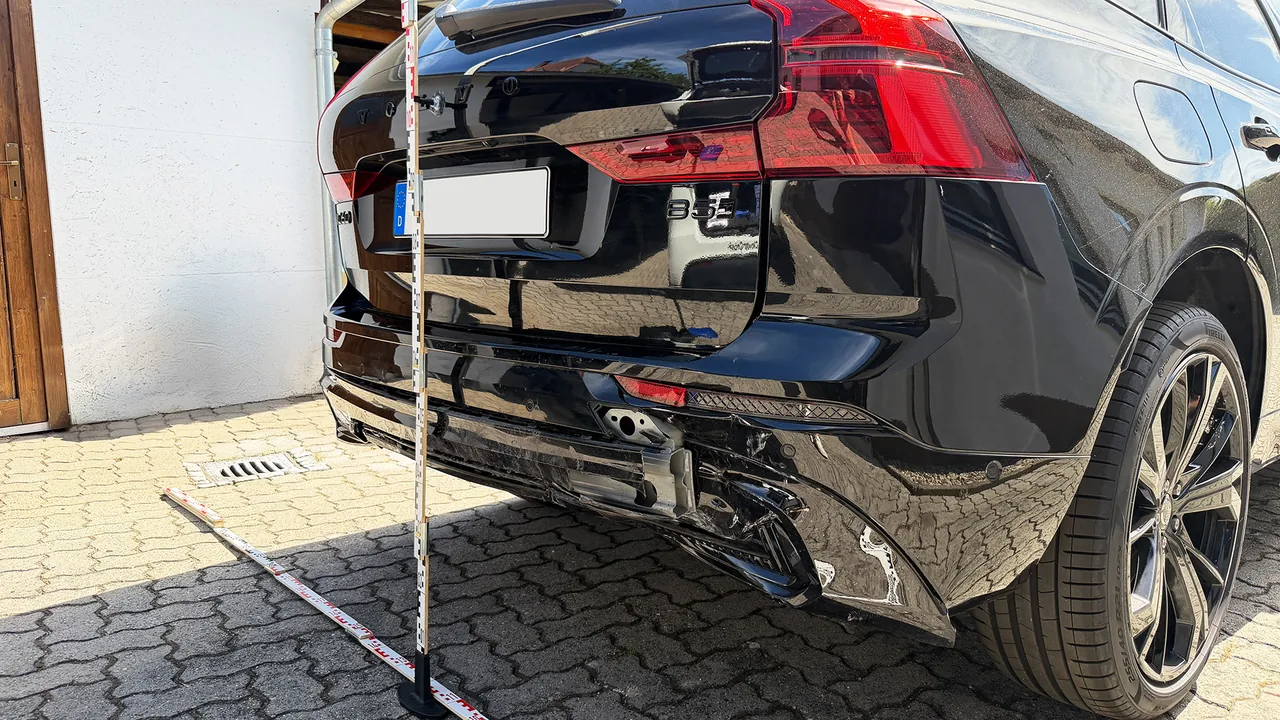
A vehicle expert's report documents how the accident happened in a clear way. It includes the damage pattern, the location of the damage and a technical assessment of the impact geometry. This answers the plausibility question that belongs to Trigger 3 in the HIS list.
We separate prior damage and new damage zone by zone. We document repaired and unrepaired areas and show the separation in the report. This helps to avoid the suspicion of "double settlement" that matches Trigger 4.
Every item of the repair cost calculation is backed up in Audatex/DAT, with labor time units (Arbeitswerte), paint work and parts. This is also true for a fictitious settlement, without flat amounts. The insurer decides on its own if it reports a fictitious settlement. The report makes the amount of damage easy to follow. The loss-of-use compensation (Nutzungsausfall) is also documented in the report. This is the compensation for the time without your vehicle.
A good report is not HIS protection. Trigger 1 (unusual number of claims), Trigger 2 (high claim amount), Trigger 5 (total loss) and Trigger 7 (returning VIN) do not depend on the quality of the documents. Here even the best report cannot stop the insurer from reporting the case to HIS. The decision is always made by each insurer on the basis of its internal criteria.
You have the right to a free data access request under Art. 15 GDPR and § 34 BDSG. You make the request in writing by mail or with the online form of Besurance HIS GmbH (Daimlerring 4, 65205 Wiesbaden). The reply must come within one month at the latest (Art. 12(3) GDPR). By phone, the content of the stored data is not given out, for data protection reasons. But you can ask about the status of your request.
Besurance HIS must answer your data access request without delay, within one month after it receives the request at the latest (Art. 12(3) GDPR). For complex requests or many requests, this period can be extended by up to two more months. Besurance HIS must tell you about this within the first month. In practice you get the reply after a few weeks. You receive the content in writing only.
No. An entry does not happen automatically after every accident. The operator names typical reasons itself: a total loss, a fictitious settlement or unusual features in an earlier claim notification. Examples are an unusual number of claims or a course of events that is hard to make plausible. A claim that is settled on actual costs and has none of these features usually does not lead to an HIS match.
A direct message in each single case is not planned. Insurers explain data processing in their general data protection notes. You receive these when you sign a contract and when you report a claim. The only reliable way to know if you are stored in HIS is the data access request to Besurance HIS GmbH.
No. For data protection reasons, the content of the stored data is given only in writing, by mail or with the online form of Besurance HIS GmbH. By phone you can only ask about the status of your request, not about the content of the stored data.
Yes, that is the purpose of HIS. All insurers in the same sector can check the system. But the sectors are separate. A KFZ-HIS entry is seen only by vehicle insurers, not by health insurers or life insurers.
Yes, during the application. In the application process you are informed about the data processing (Code of Conduct GDV), and you usually agree to the HIS check. Which sector is checked depends on the contract you apply for. A vehicle insurer checks HIS-KFZ. A private health insurer checks HIS person/life.
A report is deleted at the end of the fourth calendar year after it was first stored. If the case is reported again during the storage period, the storage is extended by four more years, up to ten years at most. Besurance HIS deletes data on HIS requests on the exact day after two years. After the period ends, the entry is deleted automatically. Source: Besurance HIS, information under Art. 14 GDPR.
Early deletion is possible if the entry is wrong, was reported by mistake, or if the reason for storage has clearly ended. Case law is not consistent. Some regional courts granted a right to erasure under Art. 17 GDPR. This was when a complete professional repair was proven (regional court of Schweinfurt, 23 O 899/20 of April 12, 2021, and regional court of Mannheim, 11 O 197/19 of October 25, 2022). Other courts denied deletion. This was when the repair confirmation could not be checked, or when diminished value remained. Diminished value is the loss of value despite a professional repair. These cases were AG München 322 C 3109/23 of July 26, 2023, AG München 345 C 21951/24 of January 10, 2025, and LG München I 17 S 6937/24 of October 25, 2024. There is no consistent BGH case law so far. You send the written request with a reason to Besurance HIS GmbH. A lawyer of your choice handles the legal assessment and the enforcement. If the request is rejected, you can file a complaint with the Hessian Commissioner for Data Protection and Freedom of Information or go to court.
An entry is not an automatic reason for rejection. But the insurer may look more closely at your application, ask for more documents, calculate a higher premium or, in some cases, refuse the application. Each insurer decides on its own responsibility.
No. HIS is purely an information agency of insurers. It has no link to Schufa, to credit agencies or to bank systems. An HIS entry has no effect on your Schufa score, your creditworthiness or other business information agencies.
Yes. Data processing in HIS is based on Art. 6(1)(f) GDPR (the legitimate interest of insurers in preventing fraud) and on the Code of Conduct of the German insurance industry (Code of Conduct GDV). The insurer's interest must be stronger than the interests of the person concerned that deserve protection. In disputed cases it makes sense to get a legal assessment from a lawyer. At the same time, you can file a complaint with the HBDI.
The reporting insurer. Besurance HIS GmbH only stores the data and gives it to other insurers in the same sector on request. If a deletion request arrives, Besurance HIS GmbH passes it back to the reporting insurer. The insurer decides if the report was justified.
The HIS check as a data access request is free, for your car and for you. Under Art. 15 GDPR you have a right to a free reply about the data stored about you. There is no fixed limit of one request per year. The company may charge an appropriate fee or refuse to reply only if a request is clearly unfounded or excessive, for example if you ask very often (Art. 12(5) GDPR). There are no processing fees and no shipping fees.
Without a fee agreement, the legal fee for a first consultation is limited to €190 net for consumers (§ 34(1) sentence 3 RVG). That is €226.10 gross. With a fee agreement, other rates can apply. Lawyer's fees may be reimbursable for a justified deletion request. The lawyer checks this in each case, and there is no general promise of success. CleverCrash receives no commission from recommended lawyers.
Do you have more questions? We take time for the first contact.
The loss in market value that remains despite a professional repair (diminished value).
View topic Knowledge hubSettlement without proof of repair, and where its limits are.
View topic Knowledge hubEconomic total loss, technical total loss and constructive total loss of a new car compared.
View topic Knowledge hubThe overview of all topic pages about vehicle damage.
Go to overviewWe take your case, and we document how the accident happened, the separation of prior damage and the repair method in the report. In a liability claim, we bill our fee directly to the other party's insurer, and you do not receive an invoice from us. A claim under your own vehicle insurance (Kaskoschaden) is different. There the insurer generally does not pay for an expert you hired yourself (§ 85(2) VVG, Insurance Contract Act). In this case we tell you the fee in advance. The insurer alone decides whether it makes an HIS report, under its internal criteria. A vehicle expert's report does not protect you from an HIS report, but it can help with the plausibility triggers. If the insurer presents its own second report on your case, we assess it technically, see report review and expert statement. We are based in Erlangen and cover the whole Nuremberg Metropolitan Region. You can find the overview at our service areas.
Legal information, not legal advice. A lawyer of your choice handles the legal assessment of your HIS entry and the enforcement of a deletion claim. CleverCrash writes the technical damage report as an independent vehicle expert.
Last updated: August 21, 2026. The page reflects the case law known at that time.
Maximilian Fromm
Independent vehicle expert, B.Sc. in Mechatronics
Maximilian Fromm is an independent vehicle expert and the founder of CleverCrash in Erlangen. He studied mechatronics. Since August 2025, he has written damage reports (Unfallgutachten) for private customers, repair shops and lawyers in the Nuremberg Metropolitan Region. He supports his customers until the insurer pays out.
