

Technically reviewed by Maximilian Fromm, independent vehicle expert (B.Sc. in Mechatronics). Last updated: September 2026
With a fictitious settlement (fiktive Abrechnung), you have the damage paid out based on the report (Gutachten) instead of having the car repaired. The repair costs are paid net, and VAT only if it was actually paid.
Receive the net repair costs and keep your car. We determine the values on the vehicle and in the regional market.
An accident is stressful enough. Now you also have to decide quickly and correctly between a fictitious settlement and an actual settlement based on real repair costs (konkrete Abrechnung). We provide the expert assessment of the damage and the market. You and your traffic law lawyer decide which legal route to take.
You want money instead of a repair, but you do not know if this is the right way for you? We explain the technical consequences, so that you and your traffic law lawyer can make an informed decision.
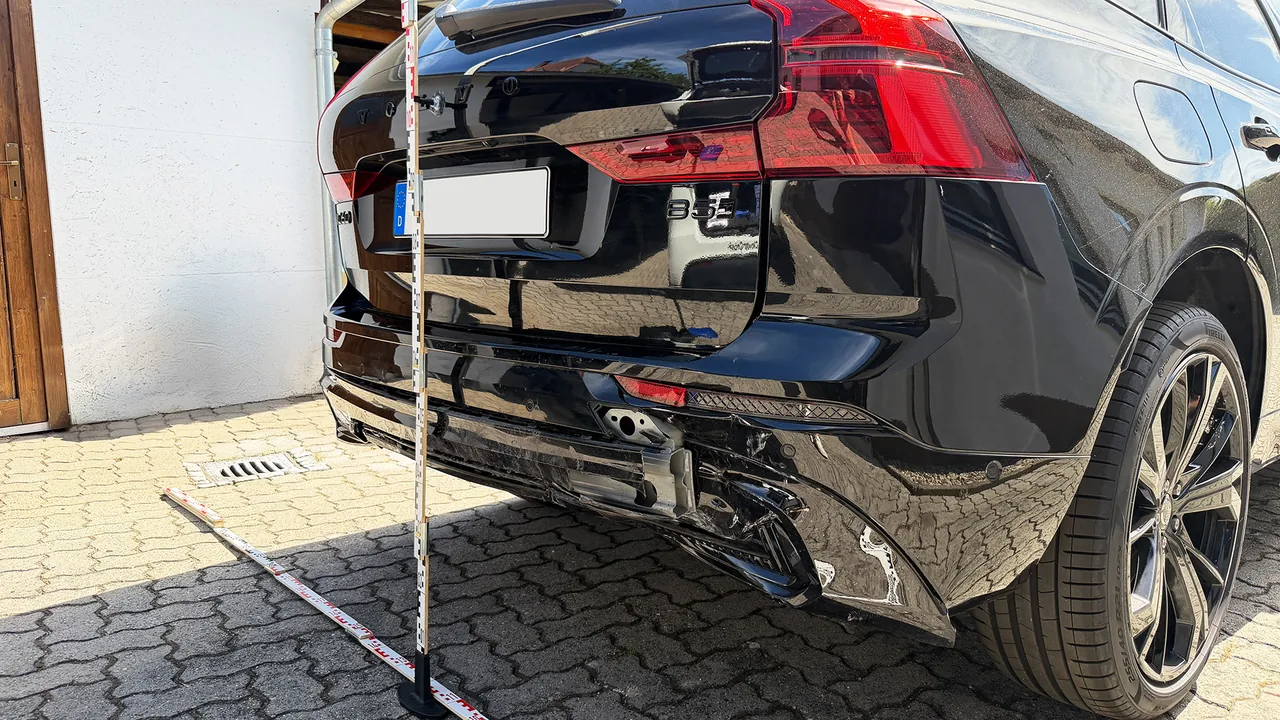
After an accident that was not your fault, many people ask whether they should repair the car or take the money. What really pays off financially depends on a few variables.
In a fictitious settlement, after an accident that was not your fault, you have the repair costs calculated in the damage report (Schadengutachten) paid out net, without actually repairing the car. You keep the car and decide yourself what to do with the money. The legal basis is § 249(2) sentence 1 of the German Civil Code (BGB).
The law gives you a real choice between two options. You can have the car repaired, or you can take the money needed for the restoration (the right to take money instead of a repair). The Federal Court of Justice has repeatedly said that you decide whether you spend the money on a repair or use it for something else (BGH VI ZR 192/05 of May 23, 2006, margin no. 9). Behind this right is your interest in keeping your own car (Integritätsinteresse): your interest in the specific car that you bought and looked after yourself.
Insurers tend to like fictitious settlements, because they save 19% VAT and part of the repair shop's additional costs. This is exactly why you should look closely at this type of settlement. Insurers regularly reduce UPE markups, transfer costs and hourly labor rates (Stundenverrechnungssätze). But according to most court decisions, these items are reimbursable when they are usual in the market.
An independent damage report is the reliable basis. A repair shop's repair estimate (Kostenvoranschlag) does not provide this. It contains no replacement value (Wiederbeschaffungswert, the price for a comparable used car), no diminished value (Wertminderung) and no market research on UPE and transfer costs. These are three building blocks that directly affect the payout.
Six points where the two options really differ, including example figures.
The difference between a fictitious and an actual settlement is whether you actually have the car repaired and submit the repair invoice (actual), or have the net repair costs from the damage report paid out (fictitious). With an actual settlement, you claim including VAT, with a fictitious one only net. Both options are legally allowed. Which one is better economically depends on the amount of damage, your wish to repair and the value of the car.
With a fictitious settlement, you are also bound to the data in the report. Repair costs AND repair time for a rental car or loss-of-use compensation (Nutzungsausfall), meaning compensation for the days without a usable car, come from the report. If you repair the car in a slower repair shop and then settle fictitiously, you cannot add the longer actual repair time (BGH VI ZR 361/02 of July 15, 2003). You cannot mix a fictitious and an actual settlement.
| Item | Fictitious settlement | Actual settlement |
|---|---|---|
| Duty to repair | no, you decide freely | yes, professional and complete |
| VAT (19%) | not reimbursed (§ 249(2) sentence 2 BGB) | reimbursed if incurred |
| UPE markups | reimbursable if usual in the region | included in the invoice |
| Transfer costs | reimbursable if brand-authorized shops locally have no paint shop of their own | included in the invoice |
| Hourly labor rate | rates of brand-authorized repair shops | rates of brand-authorized repair shops |
| Repair shop requirement | none (within the limits of § 254(2) BGB) | only if the general insurance terms (AVB) of your own vehicle insurance include it |
| Holding period | 6 months required for the full repair costs | 6 months within the 130% corridor |
| 130% rule | not applicable | only with a complete professional repair |
| Loss-of-use compensation, rental car | limited to the repair time in the report | actual duration |
| Diminished value | reimbursable | reimbursable |
Four points decide which option is open to you: who owns the car, whether you want to repair it, how long you keep it, and how high the damage is compared with the value of the car.
Find your situation below and read what follows from it. This classification does not replace a damage report. It does show you in advance what you should discuss with us and your lawyer.
This is the first decision point. For a leased vehicle and for a claim under your own vehicle insurance (Kaskoschaden), different rules apply than for your own car after an accident that was not your fault.
| Your situation | What follows | Your option |
|---|---|---|
| Accident that was not your fault, the car belongs to you or is financed | The right to take money instead of a repair under § 249(2) sentence 1 BGB belongs to the owner. The loan contract states whether the car was transferred to the bank as security. If it was, clarify with your traffic law lawyer before settling whether the bank must agree. | Both options are open. Points 3 and 4 decide. |
| Accident that was not your fault, leased vehicle | The claim for the vehicle itself belongs to the lessor as the owner, and the contracts almost always require a professional repair. If you do not meet the duty to repair, you cannot claim fictitious repair costs (BGH VI ZR 481/17 of January 29, 2019). | Usually have the car actually repaired and submit the invoice. |
| Accident that was not your fault, company car | If the company is entitled to deduct input VAT (vorsteuerabzugsberechtigt), the settlement is net anyway. The difference between the two options is therefore smaller than for private persons. | Both options are open. The tax advantage of a repair does not apply. |
| Claim under your own vehicle insurance: self-caused damage, vandalism or collision with a wild animal (Wildunfall) | Here the law of damages does not apply, your insurance contract does. Self-caused damage and vandalism are covered by collision and comprehensive coverage (Vollkasko). A collision with a wild animal is covered by comprehensive coverage (Teilkasko). Most policy terms require proof of repair and pay less if you have no invoice. | First read your own policy terms. The answer is there. |
| Shared fault (Teilschuld) or liability is disputed | You only get your share of the damage paid (liability share, Haftungsquote). As long as the share is open, the payout is not fixed, whichever option you choose. | First have the question of liability clarified, then decide. |
The repair question decides whether VAT is reimbursed and whether the range between 100% and 130% is open to you at all. The basis comes from our damage report, which compares repair costs, replacement value and residual value (Restwert) clearly.
This question sounds simple, but it decides whether VAT is reimbursed and whether the range between 100% and 130% is open to you at all.
| Your situation | What follows | Your option |
|---|---|---|
| Yes, in a specialist repair shop with an invoice | VAT is reimbursed, because it is actually incurred. Only with this option can you also reach the range between 100% and 130% of the replacement value. | Settle on actual costs and submit the invoice. |
| Yes, but by yourself or in an independent repair shop | VAT only as far as it is documented, for example on purchased parts. The scope must match the calculation, otherwise the reimbursement above the replacement value does not apply (BGH VI ZR 30/11 of November 15, 2011). | Collect receipts and get a repair confirmation (Reparaturbestätigung). |
| No, you keep the damage or sell the car | This is the fictitious settlement. You receive the calculated repair costs net and can use the money freely. If you sell within six months, a deduction of the residual value may apply, see point 3. | Settle fictitiously and keep the deadline in mind. |
| Still undecided | You do not have to decide right away. The report shows both amounts, and you decide afterwards. | First the report, then decide. |
Continued use is counted from the accident. It is the most common reason why a fictitious settlement pays less in the end than expected.
| Your situation | What follows | Your option |
|---|---|---|
| Yes, you keep driving the car | You receive the full calculated repair costs net, without the residual value being deducted (BGH VI ZR 192/05 of May 23, 2006, BGHZ 168, 43). | A fictitious settlement is most worthwhile here. |
| No, you want to sell within six months | As soon as the repair costs are above the replacement expense (Wiederbeschaffungsaufwand), insurers regularly settle only this expense, which is the replacement value minus the residual value. If the repair costs are below this expense, the full repair costs remain the settlement amount. | Have both options calculated before you sell. |
| Still open | As long as it is not clear, you should plan with the more careful option, the replacement expense. | Calculate conservatively and keep the decision open. |
Both values are in the damage report under repair costs and replacement value. Without a report, this point cannot be answered, and that is exactly why it comes last.
| Your situation | What follows | Your option |
|---|---|---|
| Under 70% of the replacement value | Low-risk range. The residual value does not matter, and the six-month period has no effect. | Both options are open. Decide by point 2. |
| Between 70% and 100% | Here the six-month period becomes important. Without continued use, only the replacement expense remains, and it is clearly below the repair costs. | Fictitious only makes sense with continued use. |
| Between 100% and 130% | The 130% corridor. It requires a real, professional and complete repair in the scope of the calculation. A fictitious settlement is ruled out here. The actual repair in the calculated scope is required (BGH VI ZR 70/04 of February 15, 2005, BGHZ 162, 161). The limit itself goes back to BGH VI ZR 314/90 of October 15, 1991 (BGHZ 115, 364). | Only actual settlement, see the page on the 130% rule. |
| Over 130% | Economic total loss (wirtschaftlicher Totalschaden). The replacement expense is paid, not the repair costs. | See the page on total loss. |
| You do not know yet | Without a report, both values are unknown. A reliable statement is not possible at this point. | First have the damage report made. |
Find the combination that matches your four answers. Each card names the requirement, the expert assessment and the next steps.
Find the combination that matches your four answers. Each card names the requirement, the expert assessment and the next steps.
Applies to: ownership or financing, no complete repair in a brand-authorized repair shop planned, repair costs under 100% of the replacement value, and for 70% to 100% also secured continued use for over 6 months. Assessment: With low to medium damage, no duty to repair and 6 months of continued use, the most net money stays with you. In a dispute, a traffic law lawyer makes the legal assessment.
Applies to: repair costs under 70% with a planned sale within 6 months, or repair costs between 70% and 100% without a secured 6-month period. Assessment: Without the 6-month period, a residual value deduction is possible in the 70% to 100% range. Your continued use is what counts. A traffic law lawyer makes a legal assessment.
Applies to: complete repair in a brand-authorized repair shop planned, repair costs under 100% of the replacement value. Assessment: With a complete repair, VAT is reimbursed as well. That is 19% extra, and a fictitious settlement would be a financial loss.
Applies to: repair costs between 100% and 130% of the replacement value. Assessment: A fictitious settlement is ruled out here. The 130% rule applies, with the duty to carry out an actual, professional and complete repair (BGH VI ZR 70/04 of February 15, 2005, BGHZ 162, 161). The limit itself goes back to BGH VI ZR 314/90 of October 15, 1991 (BGHZ 115, 364). A traffic law lawyer makes a legal assessment.
Applies to: damage covered by your own vehicle insurance. Self-caused damage and vandalism are covered by collision and comprehensive coverage. A collision with a wild animal is covered by comprehensive coverage. Assessment: From an expert's point of view, the actual repair at the partner repair shop is usually the cheaper option in this case. In our experience, the partner repair shop rates are clearly below the rates of brand-authorized specialist repair shops.
Applies to: accident that was not your fault with a leased vehicle, the owner is the leasing company. Assessment: In BGH VI ZR 481/17 of January 29, 2019 (NJW 2019, 1669), the Federal Court of Justice made clear that a lessee cannot claim fictitious repair costs without the lessor's consent if the lessee agreed in the contract to repair and did not meet this duty. A traffic law lawyer reviews the lease contract.
Applies to: repair costs over 130% of the replacement value. Assessment: Neither a fictitious settlement nor the 130% rule makes economic sense here. You receive the replacement value minus the residual value plus additional items. A traffic law lawyer makes a legal assessment.
Applies to: shared fault or unclear liability, or when the ratio of repair costs to car value is not yet known. Assessment: In your case there is no clear winner. Depending on the figures, each option can mean a difference of €1,000 to €3,000. A traffic law lawyer makes a legal assessment.
Applies to: accident that was not your fault with a company car, the registered keeper (Halter) is the company. Assessment: Three things decide the best economic option: who is the keeper and owner, whether the company can deduct input VAT, and which loss-of-use option applies. The options are lost profit, standby costs (Vorhaltekosten) or rental car. A traffic law lawyer makes the legal assessment.
Expert guidance based on the market. The result is a comparison, not a recommendation. Only the report of an independent vehicle expert and, if needed, the advice of a traffic law lawyer are decisive.
The 7 most important questions from the decision aid, summarized for the talk with your repair shop, lawyer or family.
In preparation: a checklist with seven points that should be technically clarified before you decide between a fictitious and an actual settlement.
Clarify these seven points before you settle:
Planned in addition: 6 typical reduction patterns of insurers with market orientation.
Prefer to call directly? 09131 91 66 143
This content is expert guidance based on the market. For legal questions, the checklist does not replace a traffic law lawyer.
Ten questions that we hear most often in the first talk, answered clearly.
A fictitious settlement means that after an accident that was not your fault, the repair amount calculated in the damage report is paid directly into your account, instead of you having the car repaired in a repair shop. The legal basis is § 249(2) sentence 1 BGB. The payout is net, so without 19% VAT (§ 249(2) sentence 2 BGB). The condition is an independent damage report. Diminished value, loss-of-use compensation, lawyer's fees and report costs are still reimbursed.
A fictitious settlement typically pays off if you own the car, want to keep it longer, plan no repair in a brand-authorized repair shop and act as a private person. For leasing, collision and comprehensive coverage and 130% cases, it is limited or uneconomical. Check this in the decision aid above.
In a pure fictitious settlement, VAT is NOT paid out. § 249(2) sentence 2 BGB, added on August 1, 2002, says that VAT is only reimbursable “if and as far as it was actually incurred”. If you repair the car yourself and buy the parts from a business, the VAT on the parts invoices is reimbursable.
The hourly labor rates of a brand-authorized specialist repair shop of the region, determined by the expert hired by the injured person on the general regional market (BGH VI ZR 398/02 Porsche judgment of April 29, 2003, BGH VI ZR 53/09 VW judgment of October 20, 2009). Abstract averages across all repair shops are not the standard.
Yes, if they are usual in the region. The prevailing lower court case law accepts UPE markups in a fictitious settlement, for example OLG Düsseldorf, judgment of June 16, 2008, I-1 U 246/07 (NJW 2008, 3366). Transfer costs are reimbursable if the regional brand repair shops mostly work with external paint shops, for example LG Dortmund, judgment of November 28, 2008, 17 S 68/08 (zfs 2009, 265). The expert documents the market practice in the report.
At least six months after the accident. This period applies to the full claim for repair costs without a residual value deduction, if the repair costs are between the replacement expense and the replacement value (BGH VI ZR 192/05 of May 23, 2006). If you sell the car within six months after the accident, you only receive the replacement expense (BGH VI ZR 35/10 of November 23, 2010).
No. In BGH VI ZR 192/05, the Federal Court of Justice explicitly decided that a repair is not a condition of the claim. Continued use of the car counts, also in an unrepaired but roadworthy state. If the car is no longer roadworthy, a roadworthy partial repair is required.
Only under narrow conditions. The insurer must present and prove equivalence, accessibility and usual market prices (no special prices that the shop gives only to the insurer) (BGH VI ZR 53/09, BGH VI ZR 91/09 of February 23, 2010, BGH VI ZR 337/09 of June 22, 2010). For cars up to three years old, a referral is in principle unreasonable. For older cars, it can be unreasonable if the injured person gives detailed proof of the service history at the brand-authorized repair shop (service book). In the BMW decision (VI ZR 91/09), however, the BGH approved the referral in the specific case. Whether a referral is valid depends on the individual case.
Only with the written consent of the lessor. In BGH VI ZR 481/17 of January 29, 2019 (NJW 2019, 1669), the Federal Court of Justice made clear that a lessee who agreed with the lessor to repair and did not meet this duty cannot claim fictitious repair costs without the lessor's consent. Economically, a fictitious settlement therefore rarely makes sense for leasing. A traffic law lawyer makes the legal assessment.
A fictitious settlement applies when the repair costs do NOT exceed the replacement value. The 130% rule applies when the repair costs are between 100% and 130% of the replacement value (BGH VI ZR 314/90 of October 15, 1991, BGHZ 115, 364). It requires an actual, professional repair in the scope calculated by the expert (BGH VI ZR 70/04) as well as six months of continued use (BGH VI ZR 89/07 of November 13, 2007). Courts do not agree on whether this period counts from the accident or from the end of the repair. A fictitious settlement and the 130% rule exclude each other.
Your question not here? We take time for your questions about the damage report, free of charge by phone.
When may you repair despite an economic total loss?
View topic Knowledge hubThe market discount that remains despite a professional repair.
View topic Knowledge hubThe Hinweis- und Informationssystem (HIS, the insurers' information system).
View topic Knowledge hubThe overview of all topic pages about vehicle damage.
Go to overviewA fictitious settlement is an economic decision. How far the two options are apart depends on the amount of damage, the value of the car and the VAT situation, and it is only clear once the values are determined in the report. You can get the best result if three things are in place: an expert sets the values properly, the special rules on VAT and referral to another repair shop are applied, and the regional features are documented.
You call us and describe the case in five sentences. We tell you which technical and economic figures we must determine on the car and which documents we need for the report. We do not recommend which settlement option you should choose. You and your traffic law lawyer decide which legal route to take. If you were not at fault at all, our fee and the lawyer's fees are billed directly to the other party's insurer. If shared liability is determined, you pay a proportionate part of the fee according to your liability share.

CleverCrash is an office of independent vehicle experts, not a law firm. This page is general consumer information and does not replace legal advice in an individual case.
Last updated: August 22, 2026. The page reflects the case law known at that time.
Maximilian Fromm
Independent vehicle expert, B.Sc. in Mechatronics
Maximilian Fromm is an independent vehicle expert and the founder of CleverCrash in Erlangen. He studied mechatronics. Since August 2025, he has written damage reports (Unfallgutachten) for private customers, repair shops and lawyers in the Nuremberg Metropolitan Region. He supports his customers until the insurer pays out.
