

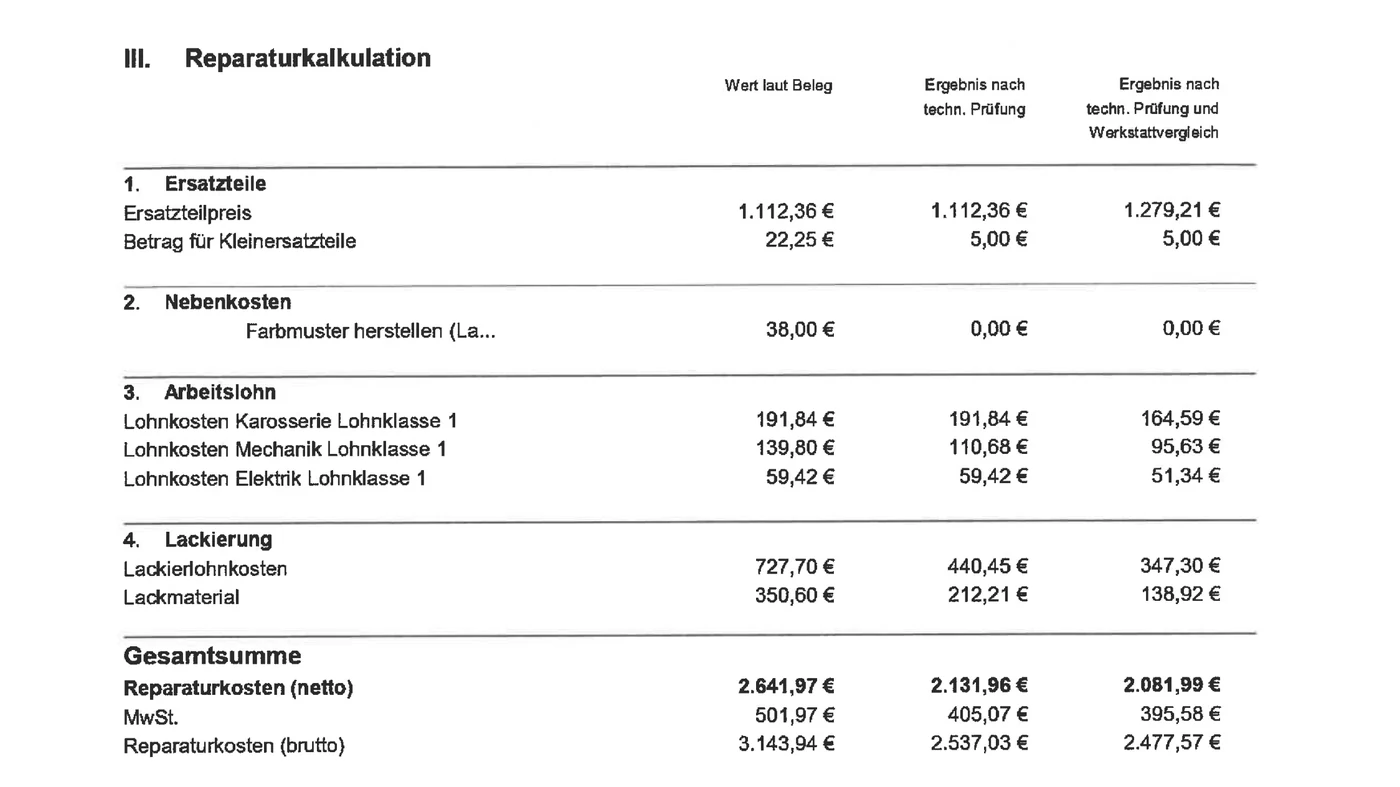
The insurer has reduced the payment (Kürzung). Or there is a report (Gutachten) whose figures do not match the damage. We check the technical side and the cost calculation. Then we put in writing which points are not technically correct.

Maximilian Fromm
Founder and Mechatronics Engineer (B.Sc.)
5.0 out of 5 stars on Google, view more than 60 reviews on Google
The same wording appears again and again in reduction letters. If you know it, you can quickly see whether the reason fits your specific car or is only general. More examples of typical reasons for reductions are in our knowledge section. The guide Challenging a vehicle report explains when an objection to the reduction is worthwhile.
| Item | What we check |
|---|---|
| Hourly labor rates (Stundenverrechnungssätze) | The insurer points to a cheaper repair shop. We look at three points: the technical equipment of the shop, its distance from you, and whether the quoted prices apply there to all customers. A rate based on an agreement with the insurer is not a market price. |
| Markups on parts list prices (UPE-Aufschläge) and transfer costs (Verbringungskosten) | Both are removed for every case in the same way, often without checking what repair shops in the region really charge. But that is exactly what matters. |
| Diminished value (merkantile Wertminderung), meaning the loss in value from the accident even after the repair | It is reduced or removed completely, often with only age or mileage given as the reason. The market decides, not a fixed rule. |
| Residual value offers (Restwertangebote), meaning offers to buy the damaged vehicle | A higher offer comes from an online salvage platform outside the region. We check whether you received it before the sale and whether it was easy to access. An offer that arrives only afterward comes too late. |
| Repair method | Repair instead of replace, paint work at a reduced paint level (Lackstufe), parts priced as used. Some body parts are made of press-hardened (very strong) steel or are glued. For these parts, the manufacturer sets the repair method, not the cost calculation. |
| Downtime | The insurer shortens the repair time or the time to buy a replacement. It also puts the vehicle in a lower class. Lowering the class because of age alone is not enough. What counts is how useful the vehicle really is. |
Send us the report and the reduction letter. First, we tell you whether the reduction gives us technical points to challenge.
We look at the reduction letter and tell you openly whether the removal makes sense technically and in the cost calculation. If it does, we say so. A statement without a technical basis helps no one.
We check labor time units (Arbeitswerte), paint levels, parts prices and repair method against the manufacturer specifications. Calculation errors are rare. Items left out are common.
We check the replacement value (Wiederbeschaffungswert), the residual value (Restwert) and the Diminished value . We compare them with the market you can actually reach. An offer from far away in Germany is not a regional market.
Usually one page. Each item we dispute has a technical reason, written plainly. It goes to you or directly to your law firm.
Our statement says whether an item is technically correct or not. It contains no legal assessment and no demand.
Your law firm decides whether and how a claim is made. We give it the technical basis it can build on.
Then the statement goes to you. You decide what to do with it. For the legal side, you need a law firm. We are not allowed to arrange one for you.
This applies to reports by other vehicle experts as well as to insurer review reports. People whose cars were damaged, law firms and repair shops can hire us.
No. We also review reports written by another vehicle expert. For a report from our own office, we of course defend our own approach.
Six items appear most often. First, hourly labor rates, when the insurer points to a cheaper repair shop. Second, markups on parts list prices and transfer costs. Third, diminished value. Fourth, residual value offers from online salvage platforms outside the region. Fifth, the repair method, for example repair instead of replacement. Sixth, downtime.
That depends on how many items are disputed and how large they are. We tell you the price beforehand, not afterward. Our free initial assessment shows whether the reduction gives us technical points to challenge.
If the report and the reduction letter are complete, it usually takes two to three business days. If the vehicle must be inspected again, it takes longer.
Send us the complete report with calculation and photos, the insurer's letter with the reductions and, if you have one, the insurer review report. If anything is missing, we tell you what else we need.
Usually not. It can make sense if there is a dispute about prior damage (Vorschäden) or hidden damage. For this, a vehicle lift is available in our workshop in Erlangen-Frauenaurach.
Yes. A large share of statements come through law firms. Then the coordination goes directly between the vehicle expert and the law firm. This saves you extra steps.
No. The statement says whether an item is technically correct or not. It contains no legal assessment and no demand. Your law firm decides whether and how a claim is made.
You reach the independent vehicle expert directly. Your free initial assessment does not obligate you to anything.
