

Technically reviewed by Maximilian Fromm, independent vehicle expert (B.Sc. in Mechatronics). Last updated: September 2026
A total loss (Totalschaden) is not necessarily a scrapped car. It also exists when a repair no longer makes economic sense (economic total loss, wirtschaftlicher Totalschaden), even if the vehicle could still be repaired technically. This page explains the three types, the 130% rule (130-Prozent-Regel) and the residual value (Restwert). It also explains what the insurer pays and how a total loss settlement works after an accident that was not your fault.
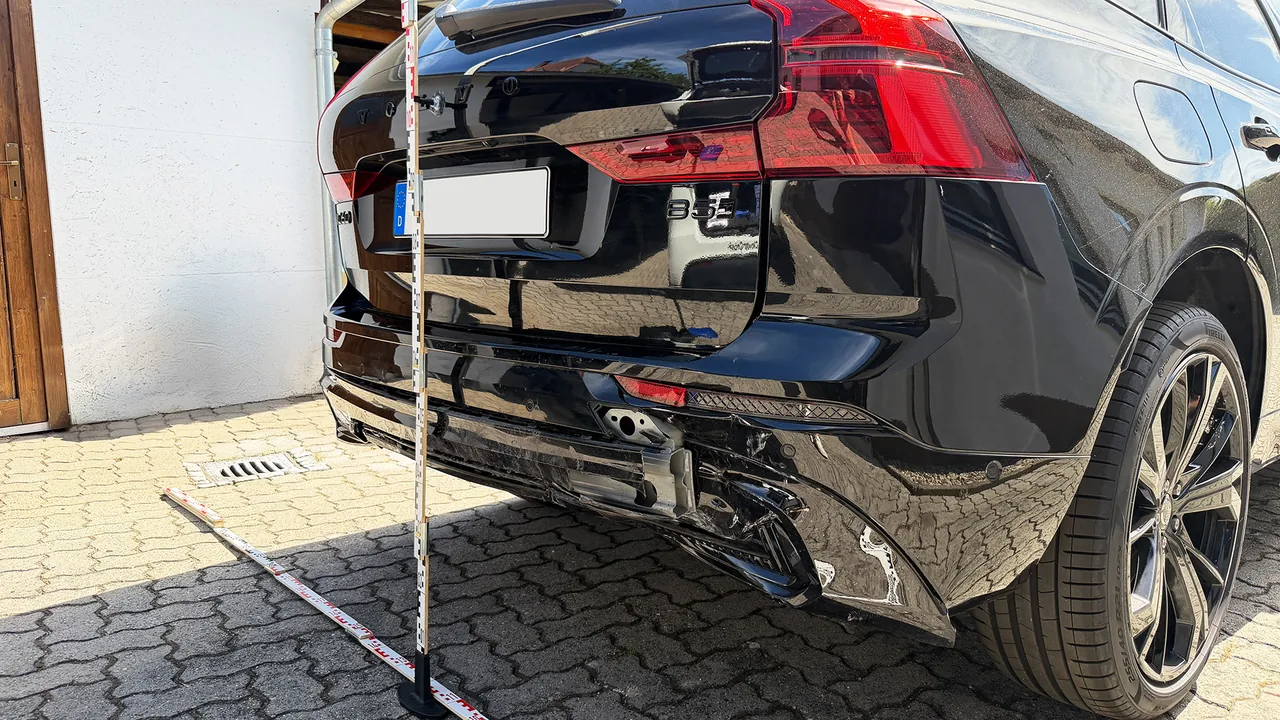
In everyday language, a total loss means a destroyed car. In German vehicle damage law, the term is different. A total loss exists when restoring the vehicle is either technically impossible or not economically reasonable. The test compares the repair costs with the replacement value (Wiederbeschaffungswert), which is the price of a comparable replacement vehicle. The damage report (Schadengutachten) provides the technical basis. The person whose car was damaged chooses the settlement method.
In damage law, there are three situations that people often mix up. The difference is not just theory. It decides which settlement options you have.
A constructive total loss exists when the car could still be repaired, technically and economically. But it would be unreasonable to ask the owner to accept the repair. A typical case is a new car with serious damage. On this page, the term means this new-car case.
Even if the repair costs are higher than the replacement value, case law allows a repair up to 30% above it. This applies if you have an interest in keeping your own car. The Federal Court of Justice set the conditions in several decisions. The main conditions are a complete repair to the calculated extent and six months of continued use. We explain in detail how the 130% limit is calculated, which conditions apply and what the relevant BGH judgments say on our page on the 130% rule.
In daily practice, most total loss cases fall into this group. The repair would be technically possible, but the car is older and its market value is lower than the damage. Here the residual value assessment, continued use and your choice can change the result by several thousand euros.
If the repair costs rise above 130% of the replacement value, the case falls under the classic total loss settlement. The replacement expense (Wiederbeschaffungsaufwand) is paid. This is the replacement value minus the residual value. A repair is not forbidden then, but you pay for it yourself.
You can find out in two steps whether a total loss exists and what is paid. First, the repair costs are compared with the replacement value. The resulting ratio shows which settlement options you have. The example below is freely chosen and simplified. It leaves out diminished value (Wertminderung) and VAT questions. It assumes a replacement value of €10,000 and a regional residual value of €2,000.
Replacement value and residual value are the two figures that every result depends on. The damage report determines both on the regional market. An online calculator can only estimate them. You can read how diminished value is counted in the 130% threshold on our page on the 130% rule.
The residual value is the market price of the damaged vehicle. According to BGH case law, it is determined on the generally accessible regional market. Usually this means three offers from local buyers. This is common practice of the BVSK, a German association of vehicle experts, after the Verkehrsgerichtstag (a German traffic law conference). According to settled BGH case law, the insurer generally cannot dictate a residual value from a nationwide online salvage platform (BGH VI ZR 132/04, BGHZ 163, 362). Sometimes you get a higher, specific offer before you sell the car, and you can accept it easily. If this happens, talk to your lawyer before you sell or scrap the car.
In an economic total loss, you often have several settlement options. You can repair within the 130% range and keep using the car, use a fictitious settlement in the 100% window, or take the total loss payout. You make this choice. A traffic law lawyer can explain what each option means for your case. The lawyer can also explain limits such as the duty to mitigate damage (Schadenminderungspflicht) under § 254 of the German Civil Code (BGB).
A common conflict: The other party uses a high residual value from a nationwide online salvage platform and arrives at a lower payout. In an independent report, the residual value is determined on the regional market according to BGH case law. A traffic law lawyer handles the legal dispute with the insurer on the basis of this report.
If the repair costs are below the replacement value, the 100% window applies. If you keep using the car for at least six months, the damage amount is typically settled on a fictitious basis without a residual value deduction, based on BGH case law. A complete repair is not required. But you must keep using the car. If needed for this, the car must at least have a partial repair so that it is roadworthy (BGH VI ZR 192/05, judgment of May 23, 2006, BGHZ 168, 43, and BGH VI ZR 35/10). As long as the car is not sold, the residual value stays a hypothetical figure (BGH VI ZR 192/05).
A self-repair is also possible within the 130% range if it is done professionally and completely to the calculated extent. You can read which proof you need and how a repair confirmation (Reparaturbestätigung) can replace a missing or incomplete repair shop invoice on our page on the 130% rule.
After an accident that was not your fault, the damage report records and calculates all relevant items properly. This documentation is the basis on which a traffic law lawyer handles the claim settlement with the insurer. In the report, we record and document:
After an accident that was not your fault, the other party's liability insurance usually pays the replacement expense in an economic total loss. This is the replacement value minus the residual value. Other items are added, such as report costs, towing costs, the flat-rate expense allowance and loss-of-use compensation. The compensation covers the time you need to buy a replacement car, as stated in the report. If the car is professionally repaired within the 130% range and used for six months, the repair costs are paid instead. A traffic law lawyer assesses which option is open in your case, based on the report.
A constructive total loss exists when the car could be repaired. But it would be unreasonable to ask the owner to accept the repair. A typical case is a new car with serious damage. A settlement based on the new-car price may be possible if you actually buy a brand-new replacement vehicle (BGH VI ZR 110/08). The term is not used in the same way everywhere. Some sources also use it for the economic total loss.
A total loss exists when a repair is either technically impossible or not economically reasonable. What counts is the ratio of repair costs to replacement value. If the repair costs are far above the replacement value, this is an economic total loss. BGH case law still allows a repair up to 130% of the replacement value if you have an interest in keeping your car. A traffic law lawyer assesses your specific case.
The Federal Court of Justice allows repairs up to 130% of the replacement value if you can show your specific interest in keeping the car. The conditions are a professional full repair to the calculated extent and at least six months of continued use. You can find the calculation method, examples and the relevant BGH judgments on our page on the 130% rule.
The independent vehicle expert sets the residual value in the damage report. Usually this is based on three comparison offers on the regional market (common practice of the BVSK after the traffic law conference). According to settled BGH case law, the insurer cannot set a binding residual value from a nationwide online salvage platform. As long as the car is not sold, the residual value stays a hypothetical figure. It does not necessarily change the final amount.
If you sell the car within six months after the accident, you typically give up your interest in keeping it under BGH case law. By selling, you receive the residual value. The claim is then usually limited to the replacement expense, which is the replacement value minus the residual value. This also applies after a self-repair (BGH VI ZR 35/10, judgment of November 23, 2010, NJW 2011, 667). From an expert's view, it helps to document clearly that you keep using the car during the six months. Keep proof such as your insurance, the HU (the German periodic vehicle inspection), fuel receipts and odometer readings. A traffic law lawyer handles the legal assessment of your specific case.
With the classic total loss settlement based on the replacement expense, diminished value usually does not apply, because the car is treated as a total loss. In a 130% case with professional repair and six months of continued use, diminished value is included in the threshold check. Claiming it in a specific case is a matter for a traffic law lawyer.
For accidents that were not your fault, the other party's liability insurance generally pays the report costs, towing costs and transfer costs. Lawyer's fees are also typically part of the damage that the other party's insurance reimburses. If you share the fault or caused the accident yourself, we explain the costs openly in advance.
With your own vehicle insurance (Kaskoversicherung), the payout follows the terms of your own contract. It does not follow the damage law that applies against the other driver. The usual measure is the replacement value minus the residual value, and the agreed deductible (Selbstbeteiligung) is subtracted from it. Some plans offer new-price or purchase-price compensation for newer vehicles. The 130% rule comes from liability law and usually does not apply in your own vehicle insurance. Comprehensive coverage alone pays only for the events named in the contract. An accident you caused yourself falls under collision and comprehensive coverage and can lead to a downgrade of your no-claims class (Rückstufung) there. Your policy terms say what your contract provides. This page covers accidents that were not your fault. We explain your claims against the other party's insurer under Your rights after an accident that was not your fault.
Not automatically. If the engine is damaged in the accident, this damage counts as accident damage. Whether it becomes a total loss depends on the ratio of the total repair costs to the replacement value. Engine damage without an accident, for example from wear or a technical defect, is not a case for the other party's vehicle liability insurance. Even with such engine damage without an accident, people speak of an economic total loss if the repair costs more than the vehicle is worth. A lawyer checks whether a warranty, statutory liability for defects or the liability of a third party applies.
Take and save photos and accident data. Do not sell or scrap the car too early. Have an independent vehicle expert inspect the damage. You may keep driving only if the vehicle is roadworthy. Talk to a traffic law lawyer about the settlement method before you sell. A sale gives you the residual value, and settlement based on the repair costs usually no longer applies. The individual steps are in our checklist after the accident. You can report the damage directly with our online form for reporting damage.
With leasing, the lessor is usually the owner and the recipient of the compensation. The lessee usually has no interest in keeping the car in the sense of the 130% rule. The lease terms decide which steps are allowed. Typically, a duty to report damage to the lessor, a requirement to use certain repair shops and a repair duty apply. We write the report independently as usual. The legal coordination with the lessor and the insurer is a matter for a traffic law lawyer.
With a fictitious settlement, private persons typically receive the net repair costs under BGH case law. VAT is paid only after an actual repair with a repair shop invoice (§ 249(2) sentence 2 BGB). This is one of the most common points of conflict with insurers. For the replacement value, the tax treatment depends on the vehicle type. For older vehicles, margin taxation (Differenzbesteuerung) usually applies. The report shows the specific calculation. The legal claim is a matter for a traffic law lawyer.
Older used vehicles are usually traded on the market under margin taxation. The VAT share is much lower than the regular 19%. This affects the replacement value. In a fictitious settlement by a private person, the VAT share is deducted accordingly (BGH VI ZR 654/15, judgment of September 13, 2016, NJW 2017, 1310). The report shows how VAT is treated in the replacement value. A traffic law lawyer handles the legal assessment of your specific case.
For a company car, the 130% rule generally applies in the same way as for a private vehicle. The difference is in VAT. Businesses that are entitled to deduct input VAT (vorsteuerabzugsberechtigt) typically do not get VAT reimbursed in addition for an actual repair. They can claim it as input VAT, so the tax does not cost them anything. For downtime, businesses may often claim rental car costs, standby costs (Vorhaltekosten) or lost profit instead of loss-of-use compensation. Tax and legal coordination is a matter for your tax advisor and a traffic law lawyer.
Interest in keeping your car, six months of continued use and a professional full repair. Open topic
The market discount that remains despite a professional repair. Open topic
Settlement without repair, and where its limit lies in the 100% window. Open topic
The Hinweis- und Informationssystem (HIS, the insurers' information system). Open topic
The overview of all topic pages about vehicle damage. Go to overview
Direct contact with the expert: For accidents that were not your fault, the other party's liability insurance usually pays the costs of an independent damage report. We check the replacement value, the residual value and whether the repair is worthwhile, from an expert's point of view. We also show the financial effects of each settlement option clearly. We come to you in all of Erlangen, Nuremberg, Fürth and the Nuremberg Metropolitan Region. Or use our online form for reporting damage. Fill it out quickly and send it. We will contact you as soon as possible.

Legal information, not legal advice. Your lawyer assesses your specific damage case. As an independent vehicle expert, CleverCrash prepares the technical damage report.
Last updated: September 2, 2026. The page reflects the case law known at that time.
Maximilian Fromm
Independent vehicle expert, B.Sc. in Mechatronics
Maximilian Fromm is an independent vehicle expert and the founder of CleverCrash in Erlangen. He studied mechatronics. Since August 2025, he has written damage reports (Unfallgutachten) for private customers, repair shops and lawyers in the Nuremberg Metropolitan Region. He supports his customers until the insurer pays out.
