

Written by Maximilian Fromm, independent vehicle expert for damage and valuation (B.Sc. in Mechatronics) · Last updated: November 5, 2026
If the accident was not your fault, the other party's liability insurance usually pays for the rental car: for the time of the repair or of buying a replacement, in a comparable class and at the usual price.

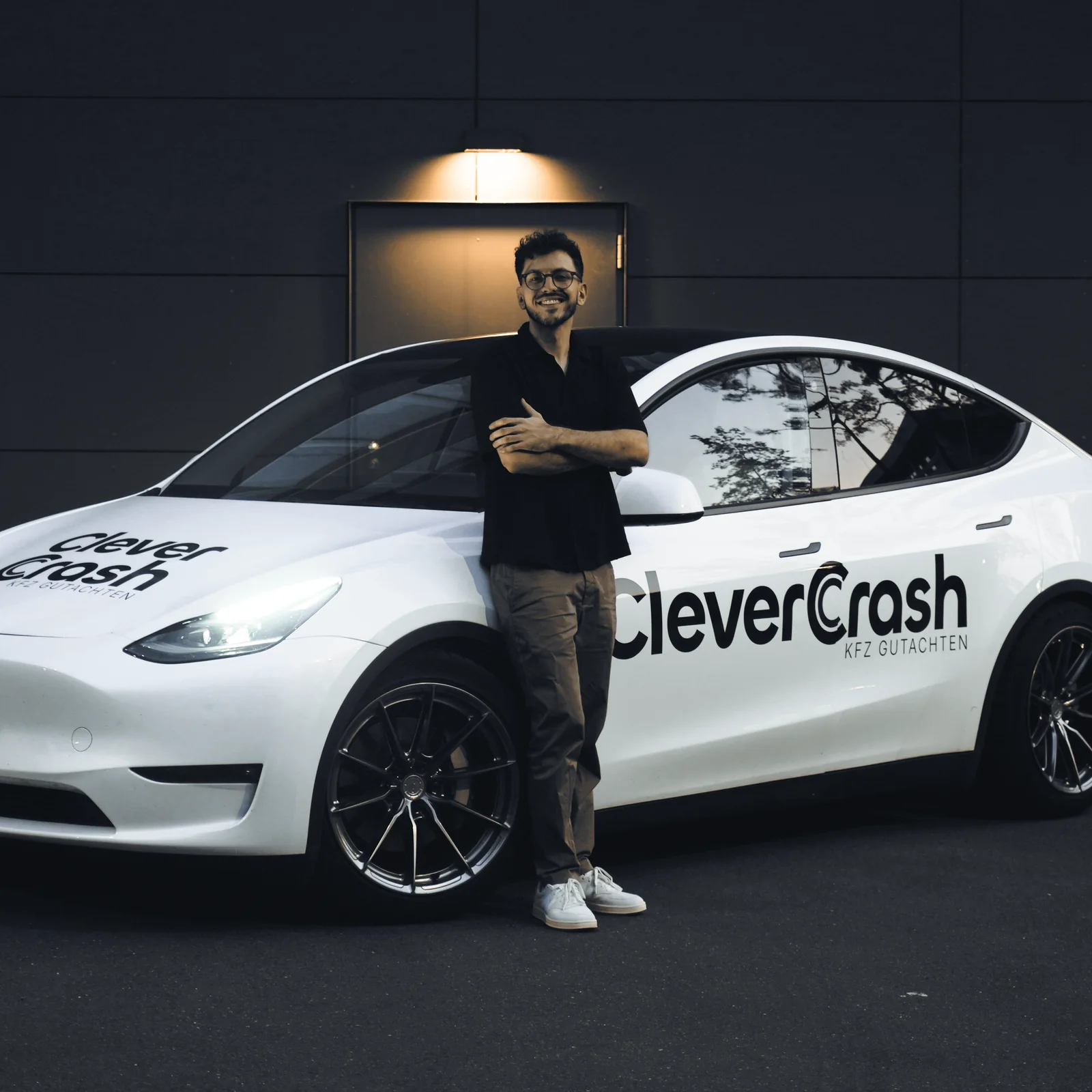
Maximilian Fromm
Founder and engineer (B.Sc. in Mechatronics)
If the accident was not your fault, it is usually the liability insurance of the other driver.
If the accident was not your fault, the other party's liability insurance usually pays the rental car costs, as long as your vehicle is out of use because of the accident and you actually need a replacement vehicle.
The person whose car was damaged can also claim compensation directly from the liability insurer of the person who caused the damage (§ 115(1) of the Insurance Contract Act, VVG). The damage includes the disadvantages caused by the loss of the vehicle. So in principle it also includes rental car costs, as long as they stay within the range described below.
If the other driver is only partly liable, for example 70%, their insurer also pays only this share of the rental car costs. The article Accident with shared fault explains what this means for the report and for follow-up costs. If the claim is settled through your own vehicle insurance (Kaskoversicherung, the insurance for damage to your own car), your policy terms decide whether and for how long a replacement car is provided. Ask your insurer.
For the duration of the downtime: the repair time or, in a total loss, the time until you buy a replacement.
The report states the expected repair time. In a total loss (Totalschaden), it states the time you need to buy an equivalent replacement vehicle. In practice, a reasonable time to think and check is added in a total loss. If the vehicle is repaired despite a total loss, the repair time applies. The downtime can be assessed based on the repair time or on the time needed to buy a replacement car. You should keep the damage low. So start the repair or the purchase of a replacement quickly, and keep the rental car only as long as your vehicle is missing (§ 254(2) of the German Civil Code, BGB).
If your vehicle is classified as roadworthy after the inspection, you usually do not need a rental car. After an airbag has deployed or with damage to the steering, the brakes or the suspension, it is usually not roadworthy. If your car cannot be driven, you usually need a replacement right away. A low-cost solution, for example a second vehicle or a borrowed vehicle, is usually better than an expensive rental car. The insurer may not repay a rental in full, and you can be left with part of the costs. The duty to mitigate damage (Schadenminderungspflicht) applies here (§ 254(2) BGB). Only the time that is really needed counts, plus the rental car class with the matching price per day. Our report states both.
If you settle your damage fictitiously (fiktive Abrechnung), meaning without a repair, you can claim rental car costs only as far as you actually rented a car. For loss-of-use compensation (Nutzungsausfall) in a fictitious settlement, the repair time stated in the report is what counts. More on this on the page Fictitious settlement.
If the repair takes longer, for example because a spare part is not available or hidden damage appears, a written explanation from the repair shop is useful in case the insurer questions the longer time. How long a claim settlement takes in total is explained in the article How long does it take until the insurer pays?.
What counts is a comparable replacement vehicle, not the most expensive one.
The Federal Court of Justice assesses the costs based on the rates that are available for renting a comparable replacement vehicle (BGH, Urteil vom 12.04.2011, VI ZR 300/09, Rn. 10). The report classifies your vehicle. This results in two separate things: a plausible rental car class and the vehicle group for the flat-rate loss-of-use compensation. This is technical guidance, not a promise from the insurer.
In principle, you may rent an equivalent replacement vehicle. If you rent a smaller car, the costs are assessed according to the class of the car you actually rented. The principle of economic efficiency (Wirtschaftlichkeitsgebot) also applies here (BGH, Urteil vom 19.05.2026, VI ZR 67/25, according to press release No. 111/2026). According to the press release, the repair shop risk (Werkstattrisiko) and the expert fee risk (Sachverständigenrisiko) that the person who caused the damage bears cannot justify a higher price. The reason is that people whose car was damaged can usually find and compare the prices of car rental companies easily.
If you rent a clearly better vehicle, you must expect the insurer to accept only the costs of the comparable class. It then usually does not pay the extra price. Regardless of the class, the insurer can make a deduction for the costs you save on your own vehicle. A traffic law lawyer can clarify whether this applies and how much it is. How daily rates for loss-of-use compensation are set is explained on the page Loss-of-use compensation.
The standard is the usual price on the local market for a comparable vehicle.
The Federal Court of Justice looks at the costs that a sensible, economically thinking person in the situation of the person whose car was damaged may consider appropriate and necessary. If there are several rates for a comparable vehicle on the local market, the person whose car was damaged can, within a certain range, in principle only ask for the lower rental price (BGH, Urteil vom 12.04.2011, VI ZR 300/09, Rn. 10).
As a basis for an estimate, the Federal Court of Justice considers two price overviews suitable in principle: the Schwacke rental price index (Schwacke-Mietpreisspiegel, called “Schwacke-Liste” in the judgments) and the Fraunhofer rental price index (Fraunhofer-Mietpreisspiegel). Both list rental car rates. Do not confuse them with the Schwacke list for used car values. The overviews are only a basis. So a court can depart from them with additions or deductions (BGH, Urteil vom 12.04.2011, VI ZR 300/09, Rn. 17 and 18, and Urteil vom 18.12.2012, VI ZR 316/11). If you claim a higher price, you may have to show that no considerably cheaper rate was available to you (Rn. 10).
With a rental car, you prove the costs. With loss-of-use compensation, you receive a flat amount for each day of downtime.
If you do not rent a car, you can, under certain conditions, ask for a flat amount for the downtime instead (loss-of-use compensation, Nutzungsausfallentschädigung). But for the same period, you only get one of the two.
With a rental car, you use a replacement vehicle and prove the costs with the rental contract and the invoice. With loss-of-use compensation, you do without a rental car and can, under certain conditions, ask for a flat amount for each day of downtime. The condition is that you would have wanted to use the car during this time and would have been able to, and that the loss affects you noticeably. If you have a second car that you can reasonably use, the claim to loss-of-use compensation may not apply. Even with a rental car, the insurer can argue that it was not necessary because of the second car. This depends on the individual case.
You cannot claim a rental car and loss-of-use compensation at the same time for the same period. But you can switch during the downtime. The table with the differences, the daily rates and the conditions in detail are on the page Loss-of-use compensation. A traffic law lawyer can clarify which option fits the individual case.
With leasing, usually the lessee makes the claim. With company cars, the way depends on how the car is used.
With a leased car, usually the lessee makes the claims for the loss of the vehicle, meaning you as the user of the car. If the lessor (the leasing company) provides a rental car itself, you usually do not get loss-of-use compensation in addition. For company cars, the following can come into question, depending on how the car is used: lost profit (income that is missing because of the downtime), the costs of a reserve vehicle that is kept ready, or rental car costs. The details and the more recent case law are on the page Loss-of-use compensation. A traffic law lawyer handles the legal assessment, and a tax advisor handles tax questions.
If the accident was not your fault, it is usually the other party's liability insurance. If the other driver is only partly liable, their insurer also pays only this share of the rental car costs. If the claim is settled through your own vehicle insurance (the insurance for damage to your own car), the terms of your contract apply. Ask your insurer whether and for how long a replacement car is provided.
For the duration of the downtime: the repair time or, in a total loss, the time until you buy a replacement, plus in practice a reasonable time to think and check. The report states the expected duration. An extension should be explained in writing.
The standard is a comparable replacement vehicle. In practice, the class depends on your own vehicle. The report classifies your vehicle and names a plausible rental car class as technical guidance. If you rent a smaller vehicle, the costs are assessed according to the class of the car you actually rented.
The standard is the usual price on the local market for a comparable vehicle. If there are several rates, the person whose car was damaged can, within a certain range, in principle only ask for the lower rental price. The Federal Court of Justice considers the Schwacke rental price index and the Fraunhofer rental price index to be suitable bases for an estimate in principle. A court can depart from them with additions or deductions.
The law does not require permission from the insurer. But § 254(2) BGB names two obligations. You must keep the damage low. You must also warn the person who caused the damage if there is a risk of unusually high damage that they neither knew nor had to know about. This warning goes to the person who caused the damage, in practice usually through their insurer. A traffic law lawyer can clarify whether you should inform them in your case.
Not for the same period. You can switch during the downtime, for example a rental car for the first days and loss-of-use compensation after that. The daily rates and the conditions for the flat amount are on the page Loss-of-use compensation. A traffic law lawyer can clarify the individual case.
Daily rates, deadlines, leasing and company cars at a glance.
Open topic Claim settlementWho pays for the report and the follow-up costs if the fault is shared.
Open topic DurationTwo clocks are running: the insurer's review period and the time until the money arrives.
Open topic OverviewThe most important rights after an accident that was not your fault, at a glance.
Open topicOn the phone, we clarify the vehicle group and the next steps. The expected repair time is stated in the report after the inspection. A traffic law lawyer can clarify whether a rental car or the flat amount is an option for you. If you do not have a lawyer yet, we can name law firms for traffic law on request. If the accident was not your fault, the other party's liability insurance usually also pays the lawyer's fees. With shared fault (Teilschuld), it pays according to the liability share (Haftungsquote). We are happy to talk to you without obligation. The downtime is part of our accident and damage report service.
We are based in Erlangen and inspect vehicles in the whole Nuremberg Metropolitan Region. You can find the overview under service areas. Go directly to the pages for Erlangen, Nuremberg and Fürth.
Legal information, not legal advice. The content of this page gives general information about rental car costs after an accident. It does not check any individual case and does not replace advice from a traffic law lawyer. If you have legal questions about your individual case, please contact a traffic law lawyer.
Last updated: November 5, 2026. The page reflects the case law known at that time. The law and case law can change.
Maximilian Fromm
Independent vehicle expert for damage and valuation, B.Sc. in Mechatronics
Maximilian Fromm is an independent vehicle expert for damage and valuation and the founder of CleverCrash in Erlangen. He studied mechatronics. Since August 2025, he has written damage reports (Unfallgutachten) in the Nuremberg Metropolitan Region for people whose car was damaged in an accident. On request, he works together with the repair shop and the lawyer. He supports his customers until the insurer pays out.
